TELESCOPE REVIEWS
Telescope Advice
Orion Reviews
Celestron Reviews
Intelliscope Reviews
FUN SCIENCE
Astronomy 101
Astronomical Tales
ET Planet Finder Kit
Space Station Live Video
Space Station Sightings
2017 Total Solar Eclipse
Animated Solar System
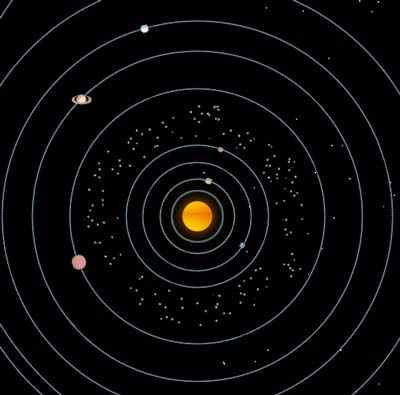 See an animation of the movement of planets in our solar system.
STARS & GALAXIES
Tonight's Sky
Name a Galaxy
Galaxy Registry Archive
 See amazing views from space
THE PLANETS
Planet Pluto
Animated Solar System
Extraterrestrial Worlds
In Search of ET
Mars: Facinating Facts
WINDOWPANE OBSERVATORY
Deep Space Bulletin
About the Observatory
Credits
Contact WPO
Looking for comets, supernovas, and Earth-bound asteroids.
2026 Best Observing Nights
This list of best observing times for 2026 is not based on weather or other sky conditions. We have simply calculated the days when the Moon sets early enough that you don't have to stay up all night waiting for it to go down, as well as when the Moon rises late enough that an early appearance of the Moon won't spoil your observing run. (Curious what's in this month's sky?)
Here are the dates when Moon conditions are optimal for night sky observing:
Our Favorite Astronomical Binoculars for under $100
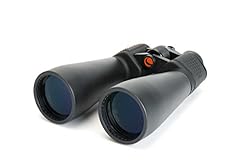

Celestron SkyMaster Giant 15x70 Binoculars with Tripod Adapter
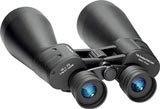
Orion 15x70 Astronomy Binoculars with Tripod Adapter
JAN 16 - 21
FEB 13 - 18
MARCH 16 - 21
APRIL 17 - 22
MAY 15 - 20
JUNE 14 - 19
JULY 14 - 19
AUG 13 - 18
SEPT 12 - 17
OCT 11 - 16
NOV 11 - 16
DEC 11 - 16
ASTRONOMY BINOCULARS
A mini telescope you can take anywhere
If you love sky gazing, you have to have a pair of astronomy binoculars!
Binoculars are a fantastic alternative to telescopes—inexpensive, lightweight, and
portable. For city dwellers where there is a lot of light pollution, binoculars are essential if
you want to see much of anything.
Binoculars enlarge and brighten the beauty and immensity of the night sky. You can see the
detail of the moon's craters, the phases of Venus, the moons and stripes of Jupiter, the awesome
jewels that dot the Milky Way, nebulae, star clusters, and comets when they're passing near.
Our favorite astonomy binoculars is the
Celestron SkGiyMaster Giant 15x70 Binoculars. These are excellent as well:
ANOTHER GREAT ASTRONOMICAL TOOL:
THE PLANISPHERE
A year-round, real-time sky map
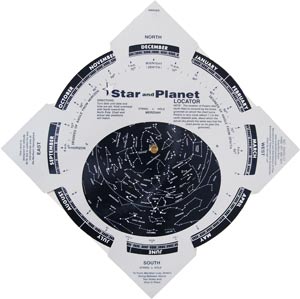 A planisphere is
a rotating star chart that allows you to dial in the entire visible sky for any day and
time of the year and with great precision. It has been called an analog star computer and was considered magical in ancient times.
A planisphere is
a rotating star chart that allows you to dial in the entire visible sky for any day and
time of the year and with great precision. It has been called an analog star computer and was considered magical in ancient times.
Planispheres show the brightest stars, constellations, notable galaxies and nebulae, as well as
the path of the Milky Way. The plane of the ecliptic is also shown, which reveals the pathway of
the planets as they appear to move across the night sky.
Purchase a planisphere for $7.95